
What Is a Court Docket
A docket is the official log of a court case. Each entry marks something that happened, such as a filing, a motion, a hearing, or an order. Read top to bottom, the docket tells the story of the case in short lines. It shows the case number, the parties, the assigned judge, and the dates that matter. A hearing calendar is a close cousin. It lists the cases set for a given day, with the time and location for each.
The docket is a map, not the whole book. It names a motion, but it does not always give you the motion itself. It notes an order, yet the signed order may live only in the paper or electronic file. In Midland County, docket lines come from the 42nd Circuit Court, the 75th District Court, and the Probate Court. Each court keeps its own case list, and the entries follow the same basic shape across all three.
Think of the docket as the index and the schedule combined. It is enough to track a case from one step to the next.
Midland County Courts With Dockets
Three trial courts in Midland County produce dockets, and each covers a different set of cases. Knowing which court holds a case tells you where the docket lives. The first court on a charge or ticket is often not the last one to decide it. A felony can start in District Court and finish in Circuit Court, so a full picture may need two dockets.
- 42nd Circuit Court: civil claims over $25,000, felony cases after bindover, divorce and family matters, personal protection orders, and appeals from District Court.
- 75th District Court: misdemeanors, felony arraignments and preliminary exams, traffic and civil infractions, small claims, landlord-tenant cases, and civil suits up to $25,000.
- Midland County Probate Court: wills, estates, trusts, guardianships, conservatorships, and mental-health proceedings, with its own hearing calendar.
The Probate Court and its juvenile side sit on Level B of the courthouse. Its calendar display lists hearing times, hearing types, and the assigned judge. The circuit and district trial-court display groups its own daily hearings the same way. You can find the full case file and record types in the broader Midland County court records collection when the docket alone is not enough.
Finding Midland County Docket Information
Most Midland County docket data lives on the statewide Michigan Judiciary system. The MiCOURT Case Search portal searches trial-court cases across the state, and the MiCOURT court-display pages post daily hearing calendars for the local courts. Both are free. Coverage depends on the court and the case type, and document images are limited by court rule. The 75th District Court also links a local ticket lookup for outstanding traffic and criminal citations.
- Open the MiCOURT Case Search portal and choose the court or court type. For Midland, the venues are the 42nd Circuit Court, the 75th District Court, and the Midland County Probate Court.
- Search by case number when you have it. The search finds cases that contain the value inside the case number.
- Search by first and last name when the case number is unknown. Name searches match participants whose name begins with the value you type.
- Narrow the results with filters such as case type category, case year, file date, status, or disposition date when those options appear.
- Open a result or a court-display entry to read the public docket data, including hearing time, hearing info, case number, and the court tracking number.
For full pleadings, certified copies, sealed matters, or older files not posted online, contact the correct court counter instead of trusting the online view alone.
Sample Midland County Docket Entry
The Midland trial-court display shows a compact set of fields for each hearing on the calendar. Each line pairs a person with a date, a time, and a case. The probate display works the same way, with a hearing type and the judge or location added. One recent trial-court entry followed the case-number pattern 2026-26-16821-SP, with hearing info such as MOTION and a location code like 3A. A probate entry showed a 9:00 AM hearing, the location listed as Judge Cole, and an attorney line.
| Field | What It Shows |
|---|---|
| Party Name | The person set for the hearing, listed as plaintiff, defendant, petitioner, or respondent. |
| Time | The scheduled hearing time, such as 9:00 AM, for that calendar day. |
| Hearing Info | The type of proceeding, such as MOTION or HEARING, sometimes with a courtroom or location code like 3A. |
| Case Number | The court's case identifier, following a pattern such as 2026-26-16821-SP with a year and a case-type code. |
| CTN | The court tracking number tied to Michigan criminal and docket displays. |
| Location / Judge | The courtroom, level, or assigned judge, shown on the probate display as a line like Judge Cole. |
| Attorney | The attorney of record when the court display includes that line. |
Behind these calendar fields, a full case can expand into more data. The MiCOURT system can carry case age, case type, charges, judge, next hearing, participants, petitions, prosecutor, and referee, though not every field appears in every case.
Reading a Midland County Court Docket
Dockets lean on short codes and legal terms. A two-letter code at the end of a Michigan case number marks the case type. For example, DM means divorce with minor children, DO means divorce without minor children, and NC means name change. A status field may read open, closed, disposed, deferred, mediation, or adr. A public-status field may read public or suppressed. Learning a few core terms makes the rest of the line clear.
- Motion
- A request asking the court to issue an order on a specific point.
- Disposition
- The final outcome or current status of a charge or case.
- Bindover
- Transfer of a felony from District Court to Circuit Court after a preliminary exam.
- CTN
- Court tracking number, a code shown on Michigan criminal and docket displays.
- Suppressed
- A public-status value meaning the case or data is not open in ordinary public view.
To confirm a hearing before you travel to the courthouse, a short routine keeps you from missing a change. Calendars can move, so check close to the date.
- Find the case on MiCOURT Case Search by case number or party name.
- Open the record and read the next-hearing date, time, and location fields.
- Check the daily court-display calendar for that court on the hearing date.
- Call the division counter to confirm if the online date and the calendar do not match.
Note: Court calendars can change on short notice, so verify a Midland County hearing with the court counter when the date is close or the case is active.
Docket vs Full Case File
The docket and the case file are not the same thing. The docket is a list of events. The case file holds the actual documents, such as complaints, motions, exhibits, orders, and judgments. A docket line may say an order was entered, but the signed order lives in the file. For a legal review, evidence, or a certified copy, the file is what you need. For tracking case progress, the docket is usually enough.
| Docket | Full Case File | |
|---|---|---|
| Format | List of dated entries | Full documents and images |
| Access | Often online and free | May need a counter visit or fee |
| Use | Track hearings and status | Legal review, evidence, copies |
Michigan Courts records-management guidance states that under MCR 8.119(H), courts cannot provide public access to document images over the Internet. Online dockets are not full document access. Electronic documents may be available at courthouse terminals or by other authorized means.
Court records are governed mainly by Michigan Court Rule 8.119, not ordinary open-records law. Public access exists unless a rule, statute, or court order restricts it. That is why online case search shows docket data and hearing dates, while full pleadings, certified copies, older files, or sealed matters route through the court counter.
Midland Court Dockets vs Land Records
People often confuse court dockets with property records, but they are separate systems. A court docket and case file cover a lawsuit, a charge, or a probate matter. Land records cover deeds, mortgages, liens, and other recorded documents tied to real estate. The courts hold the docket. A different county office holds the land records, and it uses its own online index and search vendors.
The Midland County Register of Deeds maintains the county's recorded land documents, which are public and open to anyone.
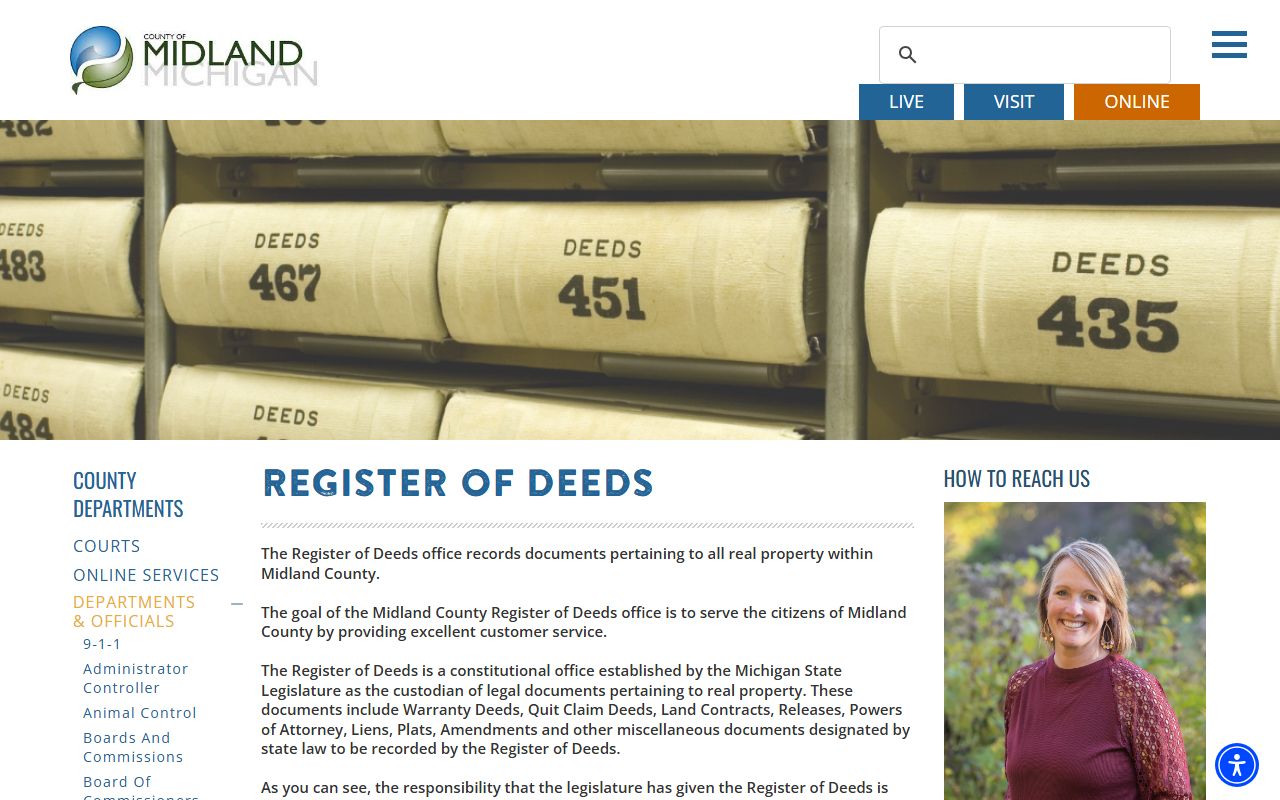
Its online index and copy purchase cover documents recorded since 1949, with recording and vault counters open on weekday business hours. If your search is about who owns a property or a recorded lien, that office holds it. If your search is about a hearing, a case status, or a court order, the docket and case file at the trial court are the right place.
Midland County Docket Access Channels
Docket information reaches the public through several channels, not only the online search. When the portal falls short, the counter, the phone, and a transcript request fill the gap. Each Midland County court division answers its own calendar questions, and the courthouse counter handles in-person review. A verbatim transcript of a proceeding is a separate, formal request.
- Online court display: daily hearing calendars for the trial courts and the Probate Court through the MiCOURT court-display pages.
- Online case search: the statewide MiCOURT Case Search for case and docket data by name or case number.
- Phone by division: Circuit Court at (989) 832-6735, District Court at (989) 832-6700, and Probate Court at (989) 832-6880.
- In person: the court counters at the Midland County Courthouse, 301 W Main Street, with Probate and Juvenile on Level B.
- Transcript request: the courts landing page links a court transcript request for a verbatim record of a hearing.
The courthouse is a weapons-free building, and all people and belongings are screened at entry. Felony dockets that begin in the 75th District Court often continue in the 42nd Circuit Court after bindover, so a complete docket history can span both courts.
Note: Court files follow Michigan Court Rule 8.119 rather than the state FOIA law, so use the court counters, not a FOIA request, for judicial records.