
What Probate Covers in Midland County
Michigan groups its trial courts into circuit, district, and probate courts. The Midland County Probate Court is the statutory court that handles wills and the safekeeping of wills, decedent estates, and trusts. It also appoints and supervises guardians and conservators. The Midland County court describes itself as primarily concerned with protecting incapacitated or mentally ill people, safeguarding their assets, and overseeing the proper transfer of assets at death. Mental-health hospitalization and treatment petitions are heard here too. That mix makes Midland County probate a court of protection as much as a court of paperwork.
Probate cases in Midland County are heard by Judge Angela M. Cole. The Probate and Juvenile Court works from Level B of the Midland County Courthouse, sharing the building with the 42nd Circuit Court and the 75th District Court. Estate files, guardianship reports, and conservatorship accounts all start and stay at that counter. The subject areas below show the full reach of a probate record.
- Wills and the safekeeping of deposited wills
- Decedent estates and the transfer of assets at death
- Trusts and trust administration
- Guardianships for adults, minors, and developmentally disabled people
- Conservatorships for adults and minors
- Mental-health hospitalization and treatment matters
- Protection of the property of incapacitated individuals
Probate Terms Defined
Probate filings lean on a handful of legal words. A quick guide helps a first-time reader move through a Midland County estate or guardianship file without guessing. These terms show up on petitions, orders, and reports across almost every Midland County probate case.
- Testator
- The person who made a will while living.
- Executor
- The person named in a will to carry out its terms and settle the estate.
- Intestate
- Dying without a valid will, so state law decides who inherits.
- Guardian
- A person the court appoints to make personal or care decisions for another.
- Conservator
- A person the court appoints to manage another person's money and property.
- Guardianship
- The legal arrangement in which a guardian cares for a minor, an adult, or a developmentally disabled person.
- Conservatorship
- The legal arrangement in which a conservator handles the finances of a protected person.
How to Search Midland County Probate Records
Probate searching splits between online tools and the court counter. The statewide MiCOURT Case Search is the main public portal for Michigan trial-court cases, and probate cases may appear depending on the court and case type. The court also runs a public calendar display. The Midland County Probate Court display can show a party name, a hearing time, the hearing type, the location or Judge Cole, and an attorney line when one is entered. Document images, though, are limited online by Michigan court rule, so full Midland County files often need a counter request.
The county's own Probate and Juvenile Court page gathers the court's role, its Level B location, and its contact block in one place. It lists Judge Cole and the direct phone lines for probate and juvenile work.
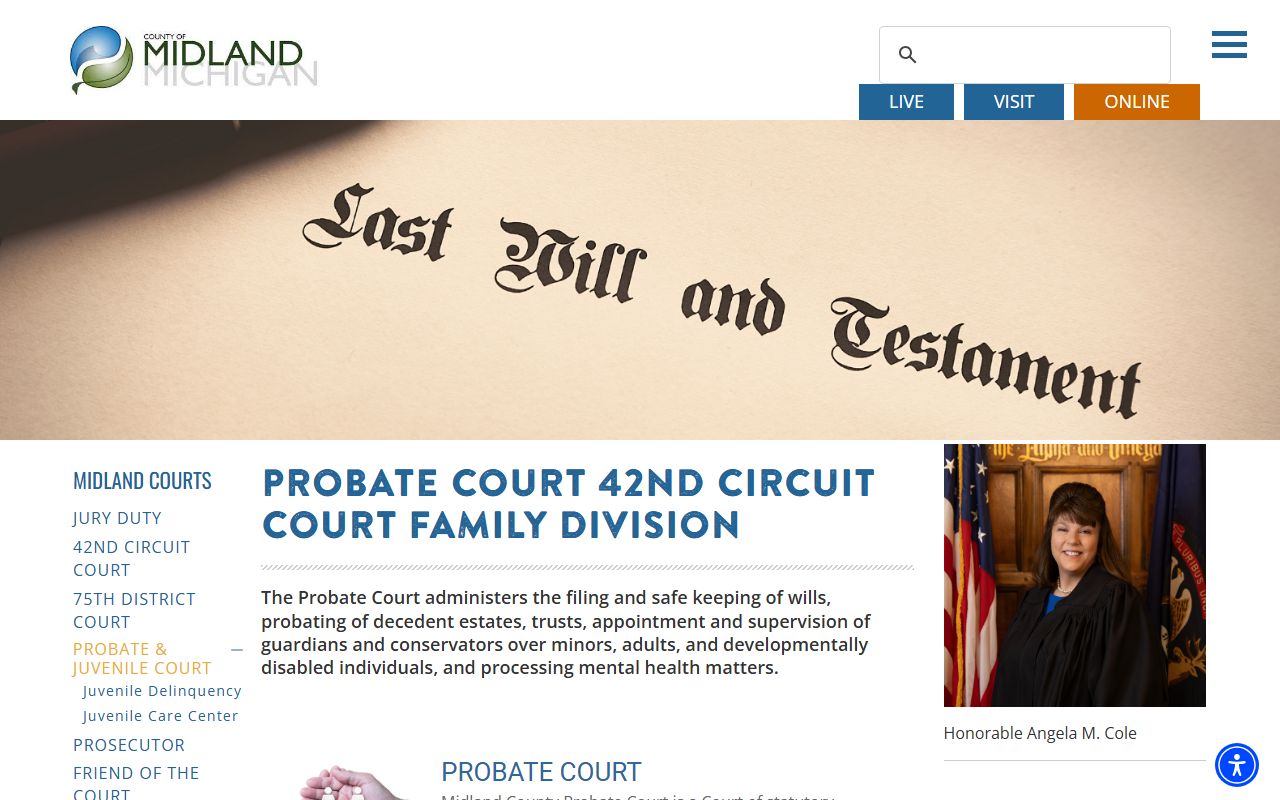
That page is the fastest way to confirm where a Midland County probate file lives before you search or visit. Use these steps to work from the online display to the actual estate or guardianship record.
- Open MiCOURT Case Search and enter a party name or case number, then set the case-type filter to probate if prompted.
- Check the Midland County Probate Court calendar display for upcoming hearing dates tied to the party.
- Note the case number, the hearing location, and any attorney shown on the display.
- Request the full file or a certified copy at the Probate Court counter on Level B, or call the court to confirm access.
Probate Search Fields
The public probate display and the statewide search use a small set of fields. Knowing which ones matter saves time, because Midland County probate case coverage online is thinner than criminal or civil coverage. The table lists the fields a searcher can expect to use or read.
| Field Label | Type | Required | Notes |
|---|---|---|---|
| Party or name | Text | Optional | Used when a public probate case is searchable |
| Case number | Text | Optional | Best way to reach an exact file |
| Case type category | Dropdown | Optional | Select probate in MiCOURT |
| Hearing date | Calendar or list | Optional | Court display shows time and hearing type |
| Court location or judge | Display field | No | Shown as a location line, for example Judge Cole |
| Attorney | Display field | No | Appears only when an attorney is entered |
Note: Michigan court rule blocks free public access to document images online, so a search result may confirm a case exists without showing every filed page.
Midland County Probate Court Office
Estate and guardianship visitors head to Level B of the Midland County Courthouse. Probate and juvenile functions share that floor, but they use separate phone lines. The card below carries the address, hours, and numbers for in-person and phone requests.
Midland County Probate Court
301 W. Main Street, Level B
Midland, MI 48640
Probate (989) 832-6880
Juvenile (989) 832-6866
Fax (989) 832-6607
Mon-Fri 8 a.m. to 5 p.m.
The courthouse is a weapons-free building, and everyone passes through security screening at the entrance. Bring a photo ID, the case number, and payment for any copy fees. For marriage and vital-record certified copies, plan a separate stop, since those route to the County Clerk office on West Ellsworth Street rather than the probate counter.
Types of Midland County Probate Records
Probate covers several distinct file types, and each carries its own contents and access rules. In Midland County, estate files tend to be the most public. Mental-health and financial records tend to be the most guarded. The table breaks down the common record types and what a reader can expect from each.
| Record type | Typical contents | Access notes |
|---|---|---|
| Estate file | Petition, will if filed, letters of authority, inventory, creditor notice, accounting, orders, closing | Many filings are public, though protected identifiers are redacted |
| Will safekeeping | Deposited will and identifying details | Often restricted while the testator is living |
| Adult guardianship | Petition, incapacity information, orders, annual reports | Sensitive medical details may be restricted |
| Minor guardianship | Petition, parent and minor data, orders, reports | Minor information may be restricted |
| Conservatorship | Financial inventory, accounts, bonds, orders | Financial and account data restricted or redacted |
| Mental health | Petitions, clinical information, treatment orders | Treated as confidential |
| Trust matters | Petitions, accountings, orders | Access depends on filing and restrictions |
Probate Filing Fees
Filing a Midland County probate case usually carries a fee, and certified copies cost extra. Specific probate filing fees, though, were not published in the county's captured official sources. Rather than guess, confirm the current amount before you file.
Specific Midland County probate filing fees are not listed in official online sources. Call the Probate Court at (989) 832-6880, or use the current SCAO and local fee schedule, before you file any petition.
The county Probate page does point to online payment through GovPros, so participants can pay certain probate charges over the web once a case exists. A fee-waiver process may be available for people who qualify, and the court can explain that path. For the exact filing cost of an estate, a guardianship, or a conservatorship, the counter and the phone line remain the most reliable answer.
Midland County Mental Health Court
Mental-health issues reach the Midland County courts in two ways. Probate handles civil hospitalization and treatment petitions for people who need care. Separately, the county runs a problem-solving docket for defendants whose criminal charges tie to mental illness. The Midland County Adult Mental Health Court is a voluntary treatment program that promotes stability, sobriety, and safety through evaluation, treatment, monitoring, and court supervision.
General criteria include age 18 or older, county residence, a diagnosis of severe mental illness, and a current charge related to that illness. The page names Judge Stephen P. Carras as Chief Judge and Andrea Diaz as coordinator.
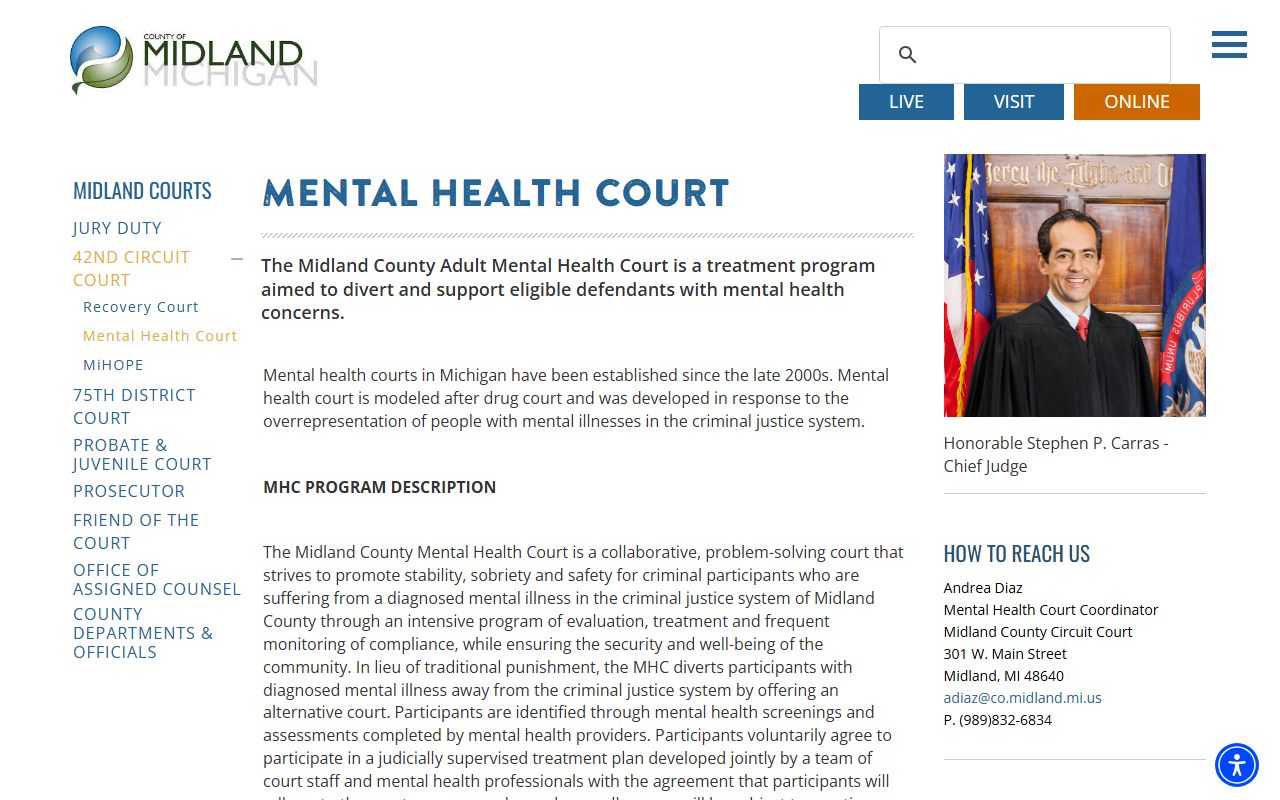
That program sits with the Circuit Court rather than the probate estate docket, but it shows how closely the county ties mental-health treatment to court oversight. Records from that treatment docket are far more guarded than a standard estate file.
The Midland County Estate Process
Opening a Midland County estate follows a set order, whether the person left a will or died intestate. The Probate Court guides each stage, from the first petition through the final closing. The steps below outline how a typical probate matter moves in Midland County.
- Identify the issue: a decedent estate, a will deposit, a guardianship, a conservatorship, a trust, or a mental-health petition.
- Contact the Probate Court at 301 W. Main Street, Level B, or call (989) 832-6880.
- Use current SCAO or local court forms and file them with the Probate Court.
- Pay the current filing fee, or ask about the fee-waiver process if you qualify.
- Watch for hearing notices; the public display may show the party, time, location, and attorney.
- For estates, expect inventory, creditor, distribution, and closing steps.
- For guardianships and conservatorships, expect appointment orders, reporting duties, and ongoing court supervision.
Note: Mental-health cases carry a strong assumption of confidentiality, so contact the court directly about authorized access rather than expecting an online result.
What Midland County Probate Records Show
A Midland County estate file reads like a timeline of the settlement. It opens with a petition or application and, when one exists, the will itself. Letters of authority follow, naming the person allowed to act for the estate. The file then collects the inventory of assets, notices to creditors, and periodic accountings that track money in and out.
Orders from the judge appear throughout, resolving disputes and approving distributions. The closing documents wrap the estate once debts and taxes are settled and property has passed to the heirs. Guardianship and conservatorship files run on a longer clock, adding annual reports and account reviews for as long as the court supervises the protected person. Divorce and marriage files, by contrast, sit with a different office; those route through the county's marriage and divorce records channels instead of the probate counter.
Restricted Midland County Probate Records
Not every Midland County probate file is open to the public. Mental-health petitions carry clinical and treatment details and are treated as confidential. Minor guardianship files can hide identifying data about children, and conservatorship accounts often redact financial identifiers. A search may confirm that a case exists yet still hold back the sensitive pages.
Adoption files are among the most protected records the Probate and Juvenile Court touches. Under MCL 710.67, adoption records are restricted and open only through statutory or court-order access. Michigan treats them as nonpublic unless a law or an order allows inspection.
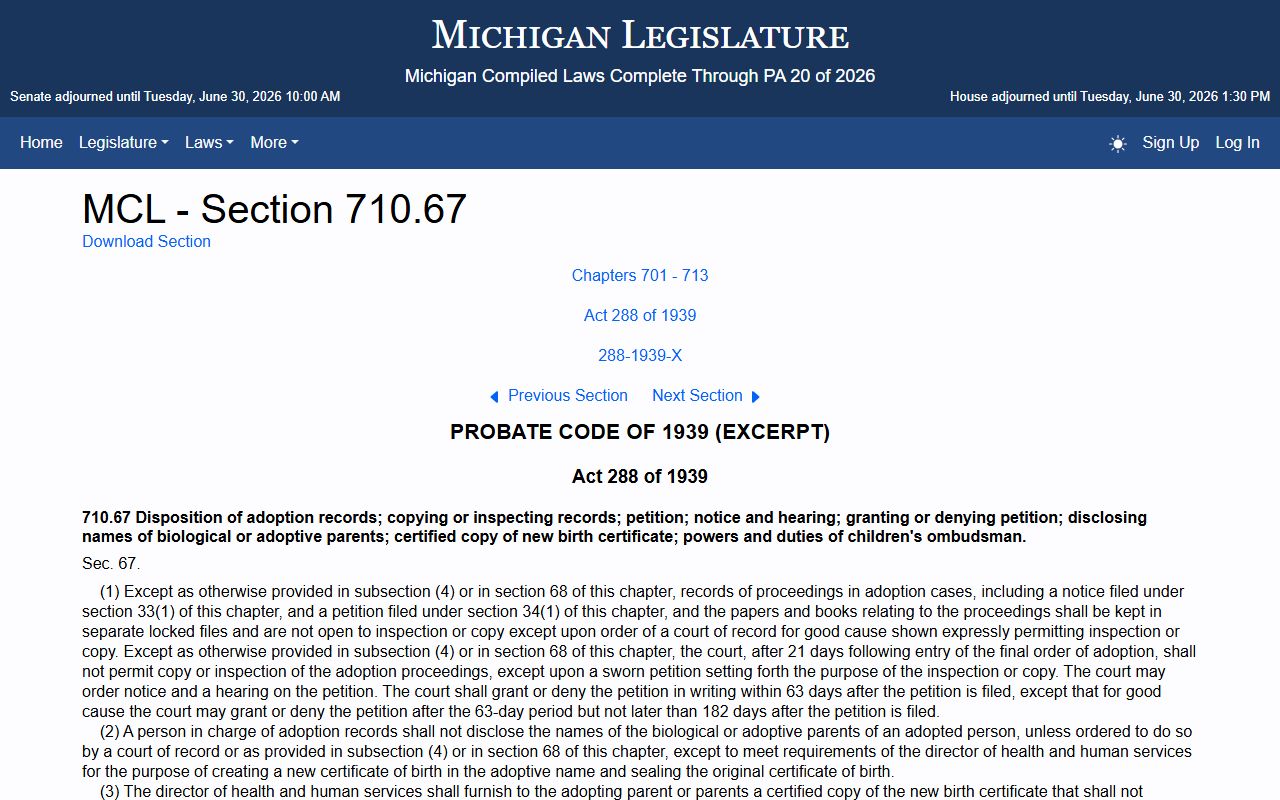
The statute text spells out who may ask and how a court controls each release. Juvenile files carry a similar shield, since the Probate and Juvenile Court also hears juvenile accountability and child-protection matters.
Under MCL 712A.28, juvenile court records are open only by court order unless another law provides access. A public lookup should never be read to imply open access to juvenile files.
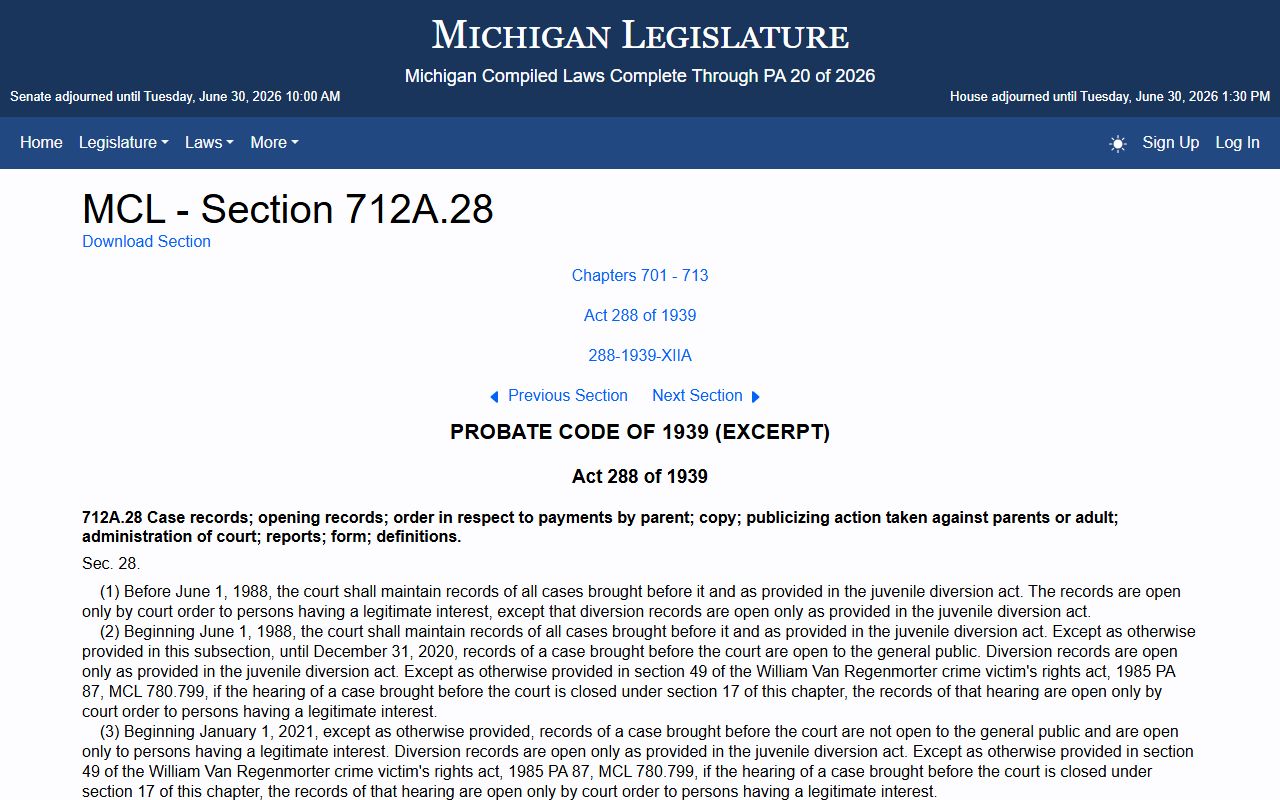
When a file is restricted, the path forward is the court itself. Call the Probate Court, ask what the statute allows in your situation, and file any order request the law requires. The Midland County Courts pages point to the right counter for each record type.