
Criminal Court Records in Midland County
A criminal court record is the case file a court opens once charges are filed against a defendant. In Midland County, the clerk keeps this file and adds to it as the case moves along. Every hearing, motion, plea, and order becomes part of the record. The file ties together the charges, the parties, the bond, and the outcome. It is broader than a single charge sheet. For the charges on their own, the county's court charge records go into more detail, while the full set of case files sits within the wider body of Midland County court records.
Midland County runs two trial courts for criminal cases. The 75th District Court is the entry point, and every criminal case prosecuted in the county starts there. It handles misdemeanors from arraignment through sentencing. It also handles felony arraignments and preliminary examinations. A felony that clears the preliminary exam is bound over to the 42nd Circuit Court for trial, plea, and sentencing. So a felony search may pull records from both courts. The district court holds the early record, and the circuit court holds the final felony file.
The county explains its misdemeanor and felony process on the official 75th District Court criminal matters page.
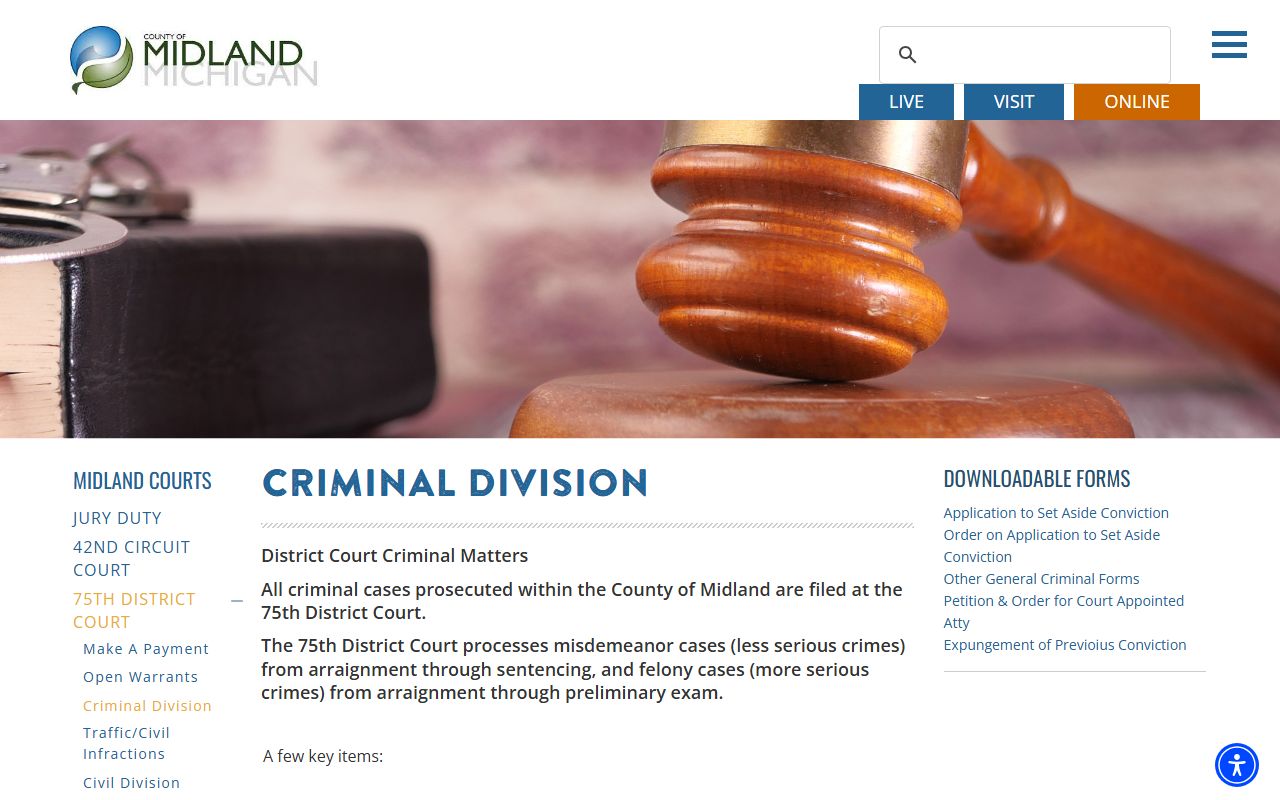
That page confirms that all criminal cases prosecuted in Midland County are filed first at the district court.
How to Search Midland Criminal Records
Most Midland County criminal cases are searchable online through MiCOURT Case Search, the statewide public case portal run by the Michigan Judiciary. It covers trial courts across the state, including the 42nd Circuit Court and the 75th District Court. The portal shows docket data, parties, hearing dates, and case status when a case is public. Full documents are a different matter. Michigan court rules limit online access to document images, so pleadings and certified copies often require a trip to the court counter.
- Open MiCOURT Case Search on the Michigan Judiciary portal.
- Search by case number when you have it, or by first and last name.
- Narrow results by court, case type category, and case year.
- Open the matching case to read the docket, charges, and disposition.
- Request a certified copy from the correct court counter when you need the full file.
Statewide criminal history is a separate search. The Michigan Department of Corrections OTIS tool lists prisoners, parolees, and probationers under current or recent supervision. It does not replace a Midland County case search, and it drops most records three years after supervision ends. For active warrants tied to a case, Midland County publishes a separate list through the district court.
Note: Online dockets update on the court's schedule, so a recent charge or plea may not appear until the clerk enters it into the system.
Stages of a Midland County Criminal Case
A Midland County criminal case moves through set stages, and each stage leaves a mark in the record. The steps run in order, though not every case reaches every step. Many cases end with a plea before trial. Others are dismissed or resolved at an early hearing. The docket lists each event with a date, so the file reads as a timeline from the first charge to the last order.
Case flow: Charges Filed › Arraignment › Pretrial and Motions › Preliminary Exam and Bindover › Plea or Trial › Disposition › Sentencing
| Stage | What Happens |
|---|---|
| Arraignment | The first hearing. The court reads the charges, explains rights and penalties, sets bond, and takes a first plea. |
| Pretrial and Motions | Parties share evidence and file motions. Many cases resolve here through a plea deal or a dismissal. |
| Preliminary Exam and Bindover | A felony hearing in district court. If probable cause is found, the case is bound over to circuit court. |
| Plea or Trial | The defendant pleads, or the case is tried before a judge or a jury. |
| Sentencing | After a conviction or guilty plea, the judge sets the penalty and any probation terms. |
Note: Misdemeanors stay in the district court through sentencing, while felonies split their record between the district court and the circuit court.
Prosecutor in Midland County Criminal Cases
The Midland County Prosecuting Attorney decides which charges to file and carries the case for the state. Michigan uses a prosecuting attorney rather than a district attorney. J. Dee Brooks has served as the elected Midland County Prosecutor since November 2014. He has worked in public prosecution for decades and spent years as Chief Assistant in the county before his election. The prosecutor's choices shape the record, from the first charge through any plea or sentence.
His background appears on the county Prosecuting Attorney page.
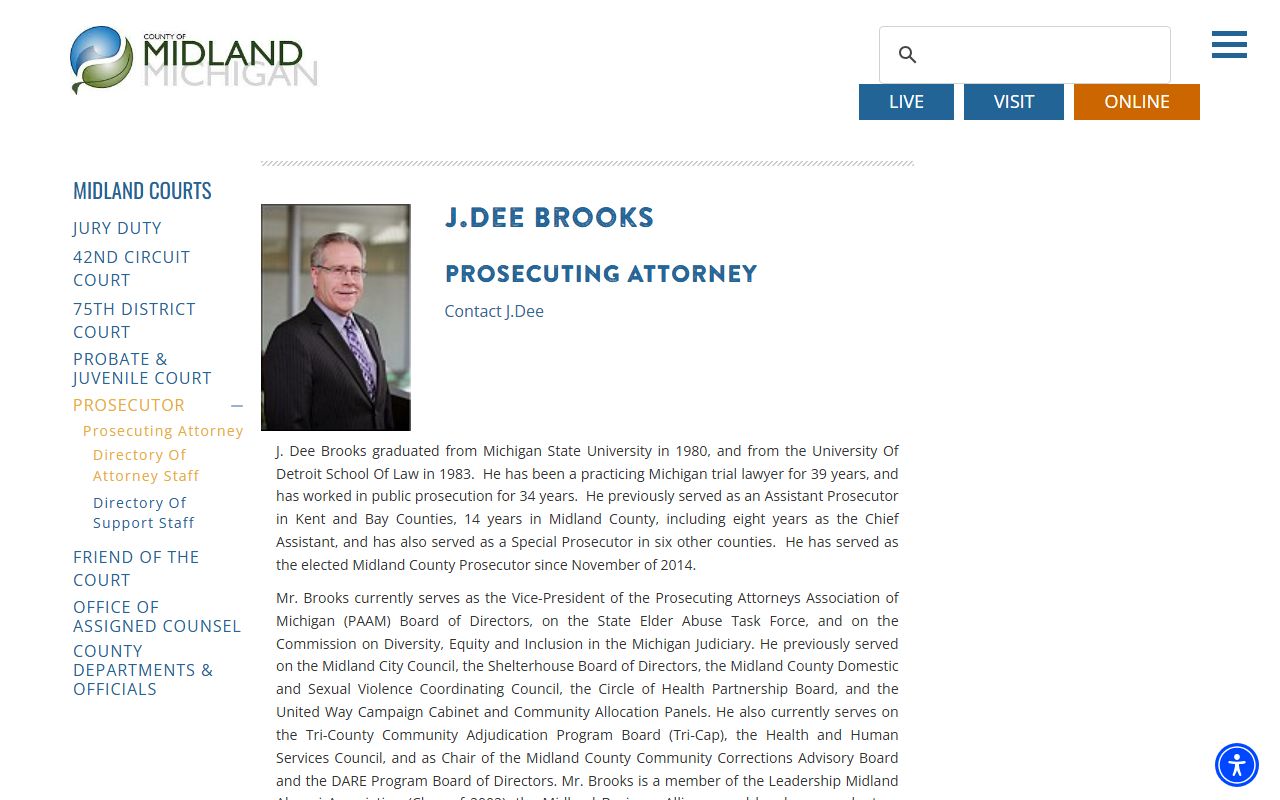
The prosecutor's office files the paperwork that opens each criminal court case.
The office also runs victim services. Victim-rights staff notify victims of their rights, answer questions, and help victims seek state compensation. The county details these roles on the prosecutor support staff page.
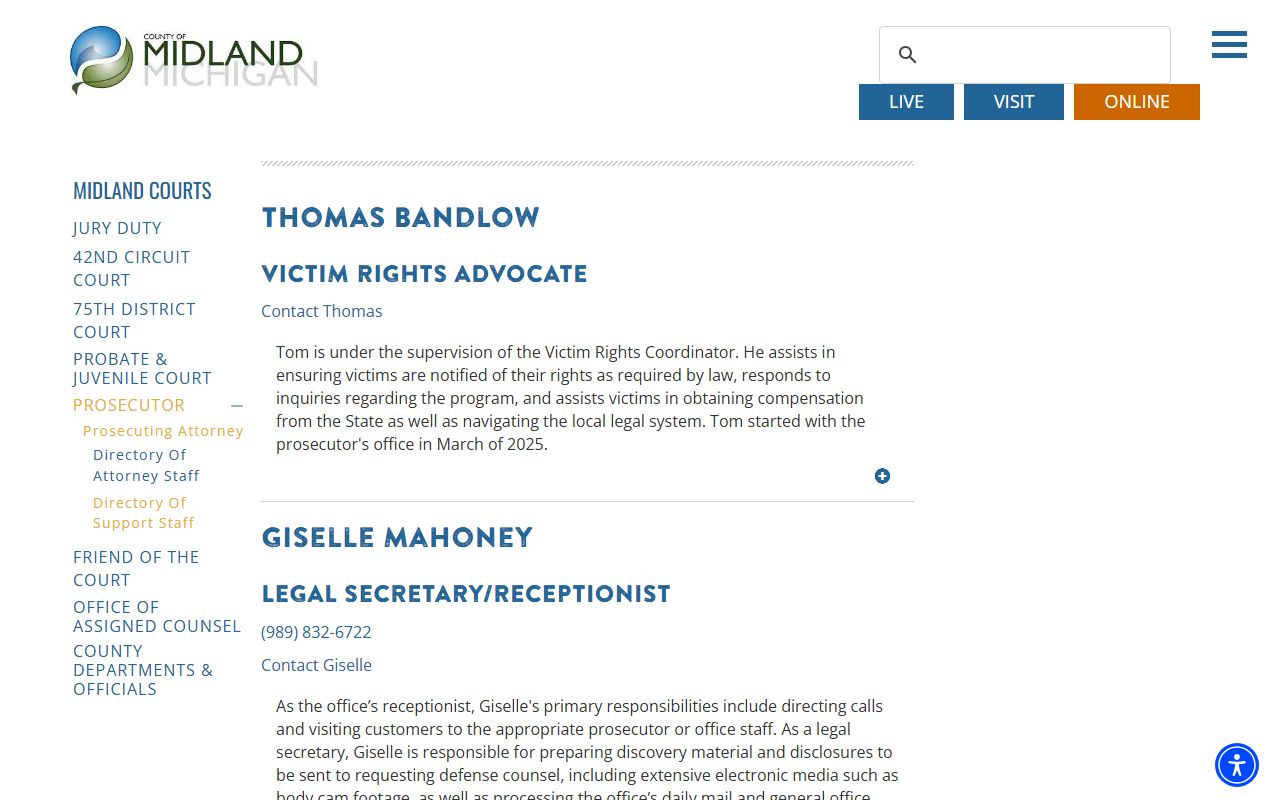
Those staff also prepare discovery for defense counsel and handle evidence such as body-camera footage.
Defendants who cannot afford a lawyer may receive appointed counsel. The Midland County Office of Assigned Counsel administers this system, and Leland Burton leads it. The office works from the courthouse on West Main Street. The county lists its address and hours on the Office of Assigned Counsel page.
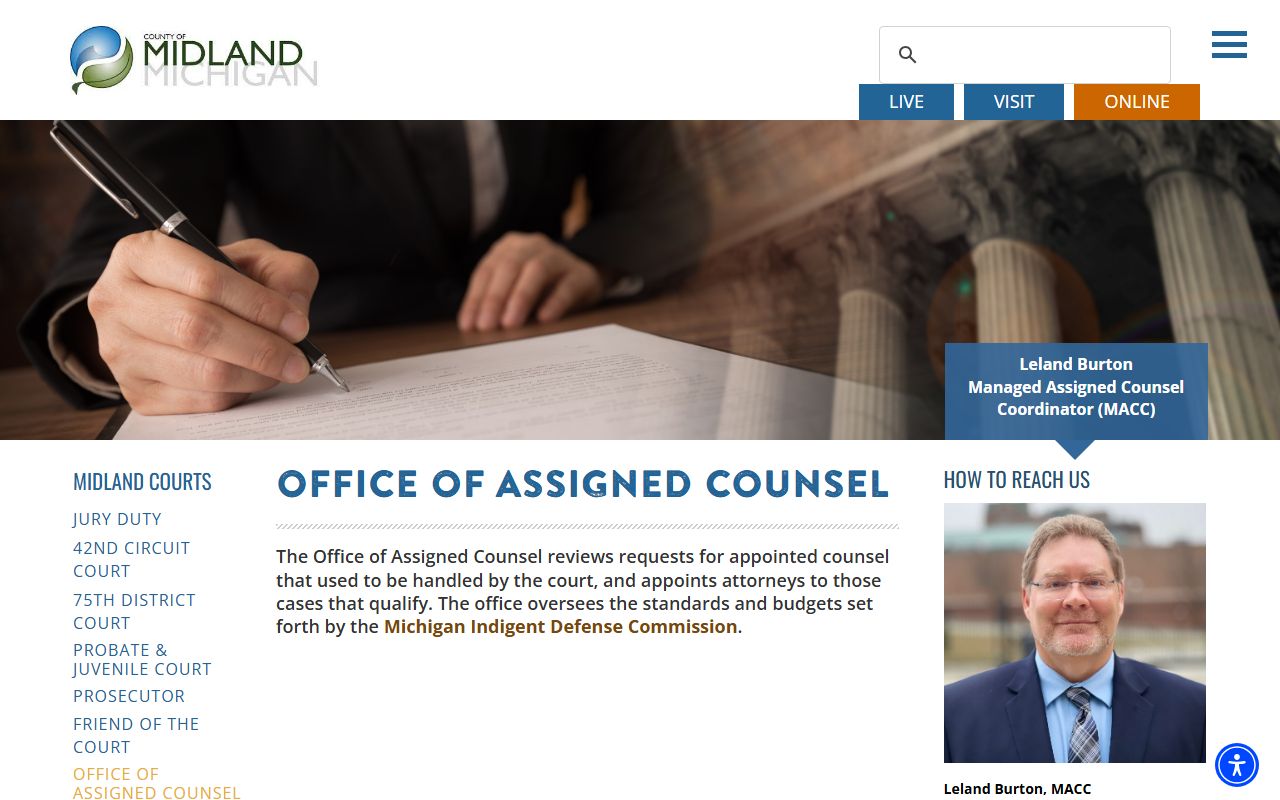
A defendant asks for appointed counsel through a petition filed with the court.
What Midland County Criminal Records Show
A criminal court file holds a set of standard fields. Some appear on the online docket, and others sit only in the full file at the court. The list below shows what a Midland County criminal record commonly records.
| Field | What It Shows |
|---|---|
| Case Number | The unique ID for the case. Michigan numbers include the year and a case-type code. |
| Court and Division | Whether the case sits in the district court or circuit court, and its criminal division. |
| Defendant | The name of the person charged, with limited identifying data. |
| Charges | Each charge, its statute or ordinance, and a charge code or abbreviation. |
| Bond | The bond amount or the conditions set to secure the defendant's appearance. |
| Plea | The defendant's response, such as guilty, not guilty, or no contest. |
| Disposition | The outcome of each charge, such as convicted, dismissed, or acquitted. |
| Sentence | The penalty imposed, including jail, fines, restitution, or probation. |
Reading Midland County Criminal Dispositions
The disposition tells you how each charge ended. One case can carry several charges with different outcomes. A charge may end in a conviction, a dismissal, or an acquittal. The sentence follows a conviction and lists the penalty. Reading both together shows the true result of the case, not just the accusation.
- Disposition
- The final outcome or status of a charge or case.
- Plea
- The defendant's formal answer to a charge.
- No contest
- A plea that accepts the penalty without admitting guilt.
- Deferred
- A status where judgment is delayed, often under terms that can later dismiss the charge.
- Probation
- Court-supervised release with conditions, set in place of or after jail.
Probation records stay in the file after sentencing. The district court probation division handles pre-sentence reports, alcohol assessments, and violation hearings for misdemeanor cases. A violation can reopen the record with new hearings and orders. So a disposition is not always the last entry in the file.
Note: A dismissed or deferred charge can still appear in a public criminal court record unless a later order seals or sets it aside.
Charges vs. Convictions in Midland County
Being charged is not the same as being convicted. A charge is an accusation, and it can be dropped, reduced, dismissed, or end in acquittal. A conviction is a finding of guilt by plea or verdict. A Midland County criminal record can show both, so readers should check the disposition before drawing any conclusion.
| Charge | Conviction | |
|---|---|---|
| Stage | Accusation | Verdict or plea |
| Burden of Proof | Probable cause | Beyond a reasonable doubt |
| Can Change | Reduced, dropped, or dismissed | Stands unless appealed or set aside |
| Public Record | Yes | Yes |
Federal Criminal Cases from Midland County
Some Midland County crimes are prosecuted in federal court instead of a county court. Midland County sits in the Eastern District of Michigan for federal cases. The U.S. Attorney's Office for that district prosecutes federal-law violations and represents the United States in criminal matters. Its role and staffing appear on the U.S. Attorney Eastern District of Michigan page.
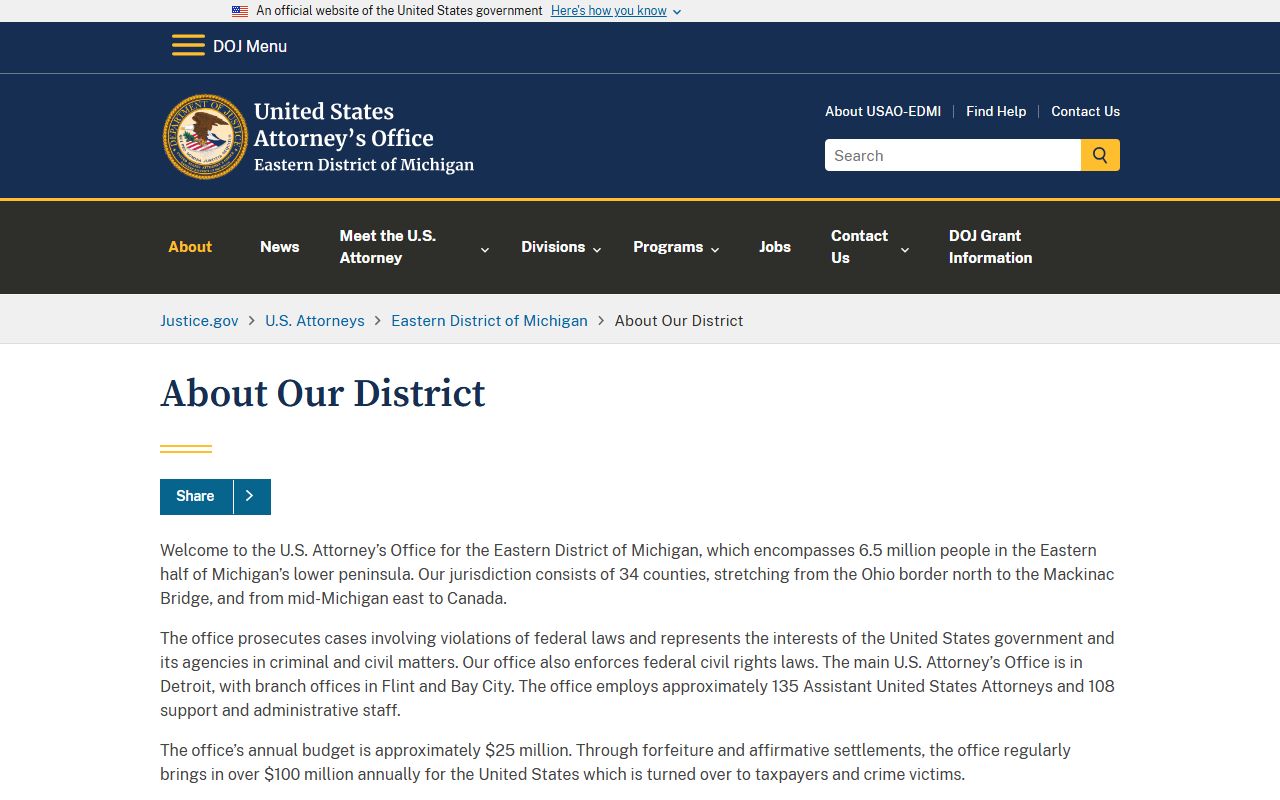
Federal criminal records are held by the federal court system, not the Midland County clerk, so they call for a separate PACER search.
The nearest federal clerk office for the district's northern users is in Bay City. Federal custody records are separate too, and they sit with the federal Bureau of Prisons rather than the county jail.
Sealed and Expunged Midland County Records
Not every Midland County criminal record stays public forever. Michigan lets qualifying people set aside certain convictions, which removes them from ordinary public view. People often use the words sealed and expunged for this, but they are not identical. A set-aside changes what the public can see, though some law-enforcement access can remain.
| Sealed | Expunged | |
|---|---|---|
| Visibility | Hidden from public view | Treated for most purposes as if it never happened |
| Law Enforcement | Limited access remains | Very limited access remains |
| Eligibility | Set by Michigan set-aside law | Set by Michigan set-aside law, with listed exclusions |
The core process runs through Michigan's set-aside statute, MCL 780.621.
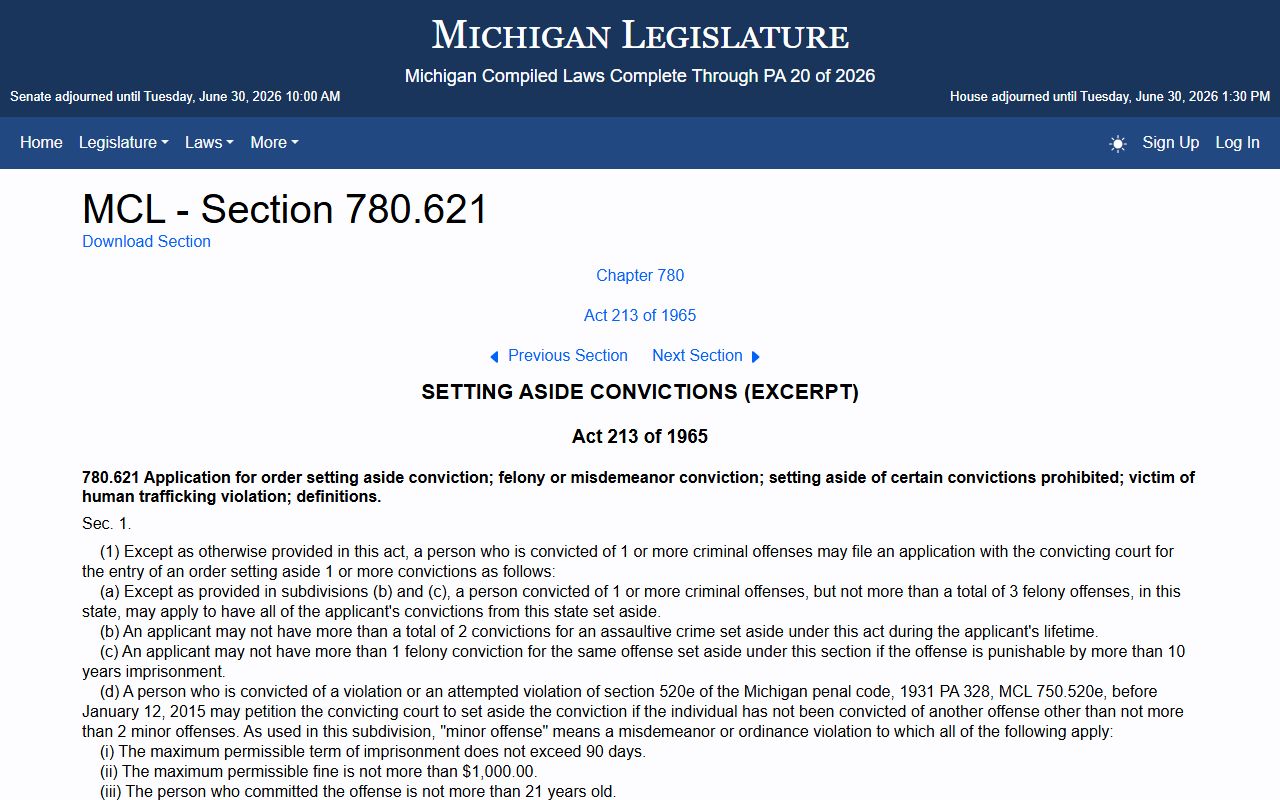
That law lets a qualifying person apply to set aside certain convictions in the sentencing court.
The path depends on where the case was decided. A misdemeanor handled start to finish in the 75th District Court is filed there, while a felony bound over to the 42nd Circuit Court runs through the circuit court file. Applicants should use current state court forms rather than a letter. Traffic offenses carry special limits, since a set-aside does not automatically erase Secretary of State driving-record effects under MCL 780.621c.
Note: A set-aside removes qualifying convictions from public search, but it does not delete every government record connected to the case.
Public Access to Midland County Criminal Records
Midland County criminal court files are public in Michigan unless a rule, statute, or order restricts them. Court records follow Michigan Court Rule 8.119 rather than the general open-records law. That rule sets how the public inspects and copies court files. The same rules limit online document images, so the online docket is not the full file. General government records, such as police administrative files, follow the state Freedom of Information Act instead.
Key Statutes:
Michigan Court Rule 8.119 - Michigan court records are public unless a rule, statute, or order restricts access.
MCL 15.233 - The state Freedom of Information Act gives a written path to inspect public records held by government bodies.
Criminal Background Checks in Midland County
A single Midland County case lookup is not a background check. A formal background check pulls together records from many courts and agencies under strict federal rules. Employers, landlords, and lenders must follow the Fair Credit Reporting Act when they use these reports. A casual online search does not meet that standard, and it should not drive those decisions.
Important: This website is not a consumer reporting agency under the Fair Credit Reporting Act, and its records may not be used for employment, housing, credit, or other regulated screening.
Restricted Criminal Court Records in Midland County
Some criminal records are closed to the public. Juvenile files, sealed cases, and set-aside convictions are the most common examples. Others carry redactions that hide personal data even when the case is public. Knowing these limits sets the right expectation before a search.
- Juvenile records, which are open only by court order under MCL 712A.28.
- Sealed and set-aside convictions removed from ordinary public view.
- Adoption records, which follow strict statutory access rules.
- Mental-health and treatment matters heard in the county's probate court.
- Suppressed cases, which the statewide portal marks as non-public.
Personal details are also protected within otherwise public files. Social Security numbers, financial account numbers, protected addresses, and victim contact data are redacted. When the online docket does not show a case, the file may be restricted, older, or not yet digitized. In those cases the district court or circuit court counter is the next step.